Presumption of Administrative Integrity in Israeli law

Deprecated: Function get_the_author_ID is deprecated since version 2.8.0! Use get_the_author_meta('ID') instead. in /var/www/sites/lawfirmbackup_200125/wordpress/wp-includes/functions.php on line 6131
What is a presumption of administrative integrity in relation to notarial actions? The presumption of integrity is a key principle in Israeli evidence law. It means that notarial certificates and actions by state authorities are considered correct and valid unless convincingly demonstrated otherwise.
The presumption is that the notary or authorities issue documents, certifications and other legal acts correctly and appropriately. If an individual wishes to prove that someone did not act properly, the burden of proof falls on them (and this is an exception to the general rule).
Our law firm provides notarial services, including signature verification, notarial translation, and document certification. As immigration attorneys, we often encounter the presumption of administrative integrity versus clients’ claims that state authorities did not act properly. This article will examine the presumption of integrity and the necessary proof.
The burden of proof to overcome the presumption of correctness
To question a notary in court about a notarial certificate, you must first show clear evidence of mistakes or problems. The court will assume the notary’s work is correct unless proven otherwise.
The same assumption that things are done correctly applies to state authorities. For example, if someone questions a state-prepared protocol or a hearing, they must provide evidence that shows these were done incorrectly. It’s up to the person making the claim to prove the errors.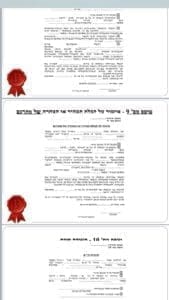
Is the Authority Required to Prove that It Acted Properly?
Regarding the presumption of administrative integrity, it was established in civil appeal 3901/11 Makhashvili v. Tax Authority, as follows:
“According to this presumption, the authority is not required to demonstrate that its actions are proper; rather, the presumption is that this is the case, and it is up to the individual claiming impropriety to overcome this presumption. The presumption of integrity mainly arises from considerations of efficiency and practicality. Firstly, you can not impose on the authority the burden of the resources wasted in judicial proceedings solely based on a vague claim raised by the opposing party. Secondly, you can not expect complete and accurate documentation accumulated over the years of all routine actions done in the daily operations of the public service mechanism (as opposed to actions of special significance that must be documented, where lack of documentation would be considered evidential damage).
Challenging an Administrative or Notarial Action is Difficult, Placing High Burden on an Individual
Section 19 of the 1976 Notary Law, states:
“Under this law and its regulations, a notary’s approval serves as sufficient evidence in legal proceedings. This means no additional evidence is needed regarding the notary’s actions, or the statements and actions of others made before the notary, as outlined in the approval.”
In the case family court case 3681/00 M.E.A.Z v. N.D.Z, it was found that the defendant did not provide enough evidence to dispute the idea present: That the notary correctly checked the identities of the parties involved and that the deceased signed the power of attorney willingly and with full understanding.
How Can Defects in the Presumption of Integrity Be Identified and Invalidate the Action?
In Originating Motion 4076/05, Shaia v. Carmi, several defects were found in a power of attorney prepared by a notary, including:
- The document was authenticated as a “blank” (empty document), and the name of the attorney was not included at the time of authentication.
- The serial number was the same as the serial number of other certificates issued by the notary.
- The principals did not understand Romanian, so the notary was required to translate the power of attorney for them but failed to do so.
- The notary should have used Form 4: “Signature Verification when the Language of the Document is Unknown to the Signer” because the document was in Romanian but did not do so.
- Israeli law requires that any verified signature to be on a document or a translation of a document that the signer understands, and without such a translation, the document is invalid.
Additionally:
- The notary did not keep copies of the power of attorney as needed by the Notary Regulations, 1977.
- The notary did not present a notary book.
- The fees listed on both the notarial certificates and receipts did not match those set by the Notaries Regulations (Fees and Services).
Due to these defects in the powers of attorney, Judge Moshe Drori issued a judgment nullifying the validity of these notarial powers of attorney.
How can you ensure that an administrative authority’s protocol is properly prepared?
It is advisable to request a recording of any hearing held by a government authority. This ensures that the protocol accurately reflects what happened. Without a recording, the protocol will be assumed correct, even if it doesn’t reflect the actual events.
Summary – Contact a Notary in Tel Aviv or Jerusalem:
As demonstrated, administrative and notarial actions carry a very high evidentiary standard that is difficult to dispute or undermine. Therefore, it is strongly recommended to have any evidence you want to preserve verified through notarial certification/authentication. On the other hand, it is crucial to ensure that there are no formal or procedural defects in the notarial action, which is why consulting with an experienced notary is important.
Additionally, if you wish to challenge or refute an administrative or notarial action, it’s important to remember that this involves significant effort. Therefore, it is advised to consult with a notary who is familiar with all the necessary procedural processes to determine if there are any procedural defects in the notarial certification/authentication.
This article was translated by: Yamit Drotman and Yasmin Dabscheck

 :
: :
:מאמרים מומלצים